Long before there was any research to point to, our founder Luke was sitting with meditation, breathwork, and Qi Gong, not because a study told him to, but because they were some of the only things that helped when chronic panic attacks had taken over his life. The science on why they worked came later. The relief came first. That order- lived experience proving something out before the lab caught up- is basically the whole idea of this principle.
We live in an age of constant access to health information, and yet more people than ever feel confused, overwhelmed, and unsure where to turn. That’s not a coincidence. Some of the noise is social media. A deeper layer of it is an old standoff: modern medicine on one side, rigorous and evidence-based, remarkable in what it can do, but narrow in its focus. Ancient traditions like Ayurveda and Traditional Chinese Medicine on the other, time-tested across thousands of years of real-world use, frequently dismissed by the mainstream for lacking the kind of evidence modern science demands.
Both Sides Have a Point. Both Sides Have Blind Spots.
Modern medicine’s insistence on randomised controlled trials as the gold standard is understandable; rigour matters. But that same insistence has led to the dismissal of practices refined over centuries of real-world application simply because they hadn’t yet been run through a formal clinical process. Meanwhile, some practitioners within ancient traditions have responded by rejecting modern medicine outright, occasionally spreading misinformation about life-saving advances in the process. Neither extreme serves anyone well.
It’s Also Worth Being Honest About the Role of Money
Modern medical research is largely funded by pharmaceutical companies that need to patent a compound to make a return on it. Ancient wisdom, built on lifestyle interventions, whole foods, and practices that can’t be patented, has never had that same financial engine behind it. There’s real evidence for how much that shapes outcomes: a Cochrane review of industry-funded drug trials found they were meaningfully more likely to report favourable results than independently funded studies, not because the science is necessarily worse, but because funding shapes what gets studied, how, and what gets published. That doesn’t make ancient wisdom less valid. It goes a long way toward explaining why the integration of the two has been so slow.
The Gap Is Narrowing, One Study at a Time
This is where it gets encouraging. Researchers are increasingly studying meditation, breathwork, and fasting, practices humans have leaned on for millennia, with the tools of modern science, and the results are catching up to what people already knew from lived experience.
Meditation, rooted in Buddhist and Vedic contemplative traditions going back thousands of years, now has a substantial evidence base behind it: a major systematic review and meta-analysis found meditation programmes produced consistent reductions in anxiety, depression, and stress across a wide range of clinical populations. Breathwork tells a similar story. Yogic pranayama, deliberate breath control practised for well over two thousand years, turns out to measurably shift the body’s autonomic balance: slow, paced breathing reliably increases heart rate variability and vagal tone, markers linked to better stress regulation and cardiovascular health. And fasting, present in some form across nearly every major spiritual and healing tradition, is now understood mechanistically: extending the gap between meals triggers a metabolic switch from glucose to ketone-based energy, associated with increased stress resistance and a reduced risk of several chronic diseases.
Meanwhile, thoughtful practitioners within ancient traditions are increasingly open to the diagnostic tools modern science offers. The gap really is narrowing, from both directions.
You Don’t Have to Wait for the Two to Fully Merge
As the CEO of your own health, you don’t need modern medicine and ancient wisdom to fully integrate before you can draw on both, right now, with discernment. Ancient wisdom offers a grounded, holistic framework rooted in the rhythms of nature and generations of insight from our ancestors and beyond. Modern science offers precision and tools to understand our own biology in ways our ancestors simply didn’t have access to. Together, they offer something neither provides alone.
Where the Line Is
Caution still matters, on both sides. The wellness space has its share of false promises dressed up as ancient tradition, just as pharmaceutical marketing has its own share of overreach dressed up as science. Research, discernment, and a healthy respect for your body’s own signals go a long way. And nothing here overrides urgent medical need: acute or life-threatening conditions always call for immediate conventional care, full stop, regardless of how integrative your everyday approach is.
Go Deeper
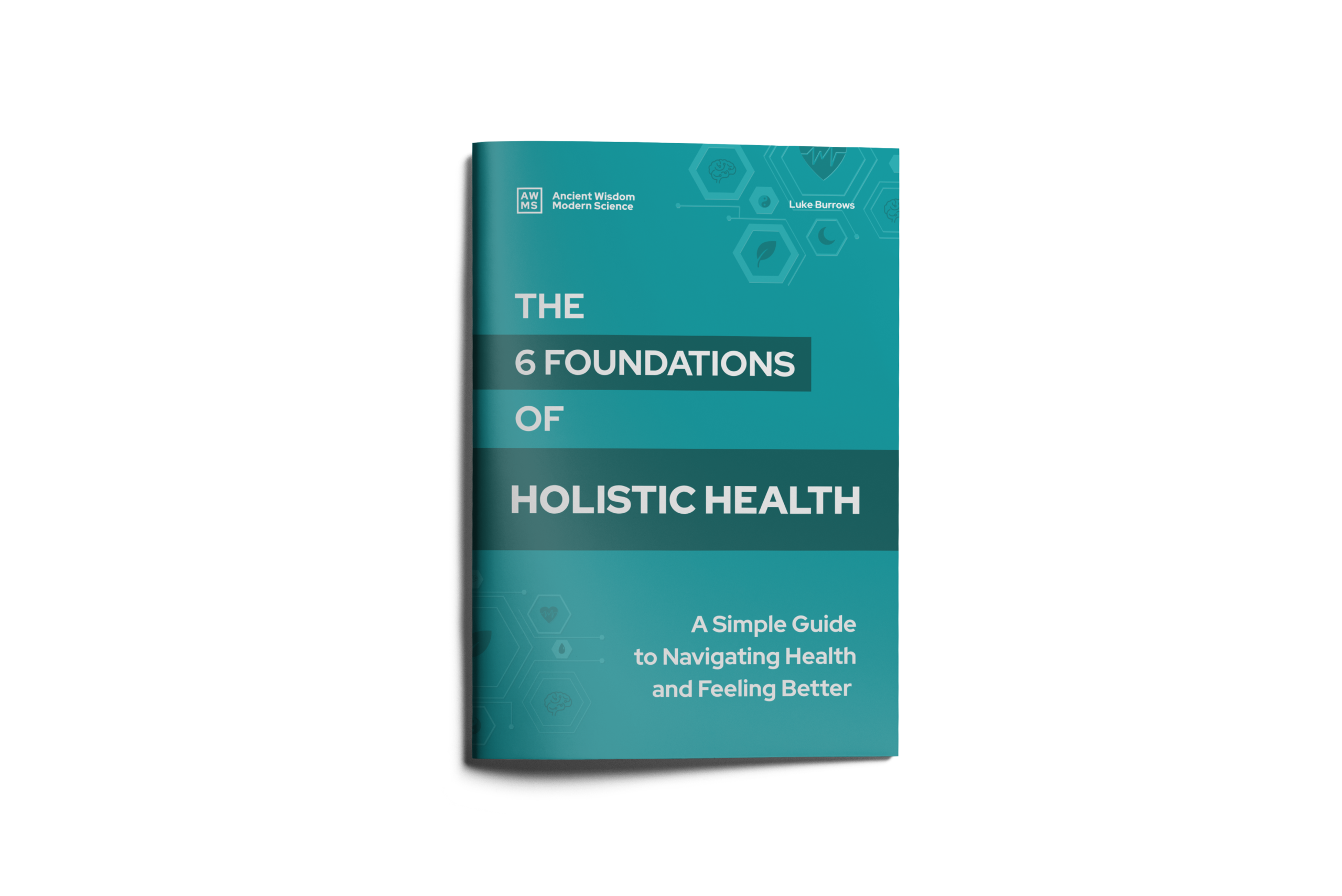
This is the sixth of six AWMS principles. If this has resonated, all six are in The 6 Foundations of Holistic Health, a free guide worth keeping close as you navigate your own path to true health.
TL;DR
Modern medicine and ancient wisdom have more in common than their standoff suggests. Both have genuine value; both have real limitations, and both are shaped by forces beyond pure evidence, including, honestly, money. Meditation, breathwork, and fasting, practices humans relied on for millennia, are now backed by real modern research: on stress and anxiety, on heart rate variability and vagal tone, on metabolic health. Neither tradition needed to wait for the other. Draw on the best of both, with discernment, and you get something neither offers alone.
Key Takeaways on Ancient Wisdom and Modern Science
- Recognise complementary strengths: Modern medicine delivers evidence-based clinical rigour, while ancient traditions offer centuries of time-tested practical experience. Combining both gives you a complete view of your health.
- Acknowledge financial influences: Pharmaceutical funding shapes which treatments receive clinical trials. Non-patentable lifestyle habits lack big financial engines, but that does not reduce their value.
- Observe the growing evidence base: Clinical research now validates ancient practices like meditation, breathwork, and fasting, proving their direct impact on stress regulation and cellular repair.
- Take charge of your health: You can learn to combine ancestral lifestyle frameworks with modern medical diagnostics right now without waiting for the two fields to completely merge.
- Maintain smart boundaries: Practise discernment in daily wellness, but seek immediate conventional medical care for any urgent or life-threatening health issues.
FAQs for Ancient Wisdom Meets Modern Science: Why Not Both?
Why has modern science taken so long to validate ancient health habits?
Modern research requires substantial funding, which often comes from pharmaceutical companies seeking patentable products. Natural lifestyle practices cannot be patented, so they rarely receive the same research funding.
How does breathwork improve your physical health?
Controlled breathing shifts your autonomic nervous system. Paced, slow breathwork increases your heart rate variability and vagal tone, which directly improves how your body manages stress and supports heart health.
Can you safely combine modern medical tools with traditional wellness?
Yes, drawing on both gives you a balanced approach. Modern medical tests offer detailed biological data, while traditional habits support your daily lifestyle choices. When you learn to blend both, you get the clearest picture of your health.
When should you prioritise modern medicine?
Modern medicine is essential for acute, severe, or life-threatening conditions. Traditional health habits support daily resilience, but urgent medical events require immediate conventional clinical care.
How does fasting support your metabolic health?
Leaving longer gaps between your meals causes your body to switch from burning glucose to burning ketones. This metabolic switch improves your stress resistance and lowers long-term health risks.
This is a framework born from lived experience, not medical advice, and is for informational purposes only, even if and regardless of whether it features the advice of physicians and medical practitioners. This article is not, nor is it intended to be, a substitute for professional medical advice, diagnosis, or treatment and should never be relied upon for specific medical advice. If something here raises questions about your own health, please visit a qualified professional.